The first day of band camp is a magical time.
Freshmen arrive carrying brand-new marching shoes.
Parents arrive carrying cameras.
Band directors arrive carrying clipboards.
And drum majors arrive carrying enough responsibility to power a small city.
By approximately 1:47 p.m., however, something strange begins to happen.
The sun is blazing.
The field is radiating heat.
The trumpets are asking how much longer rehearsal will last.
The drumline is pretending not to be tired.
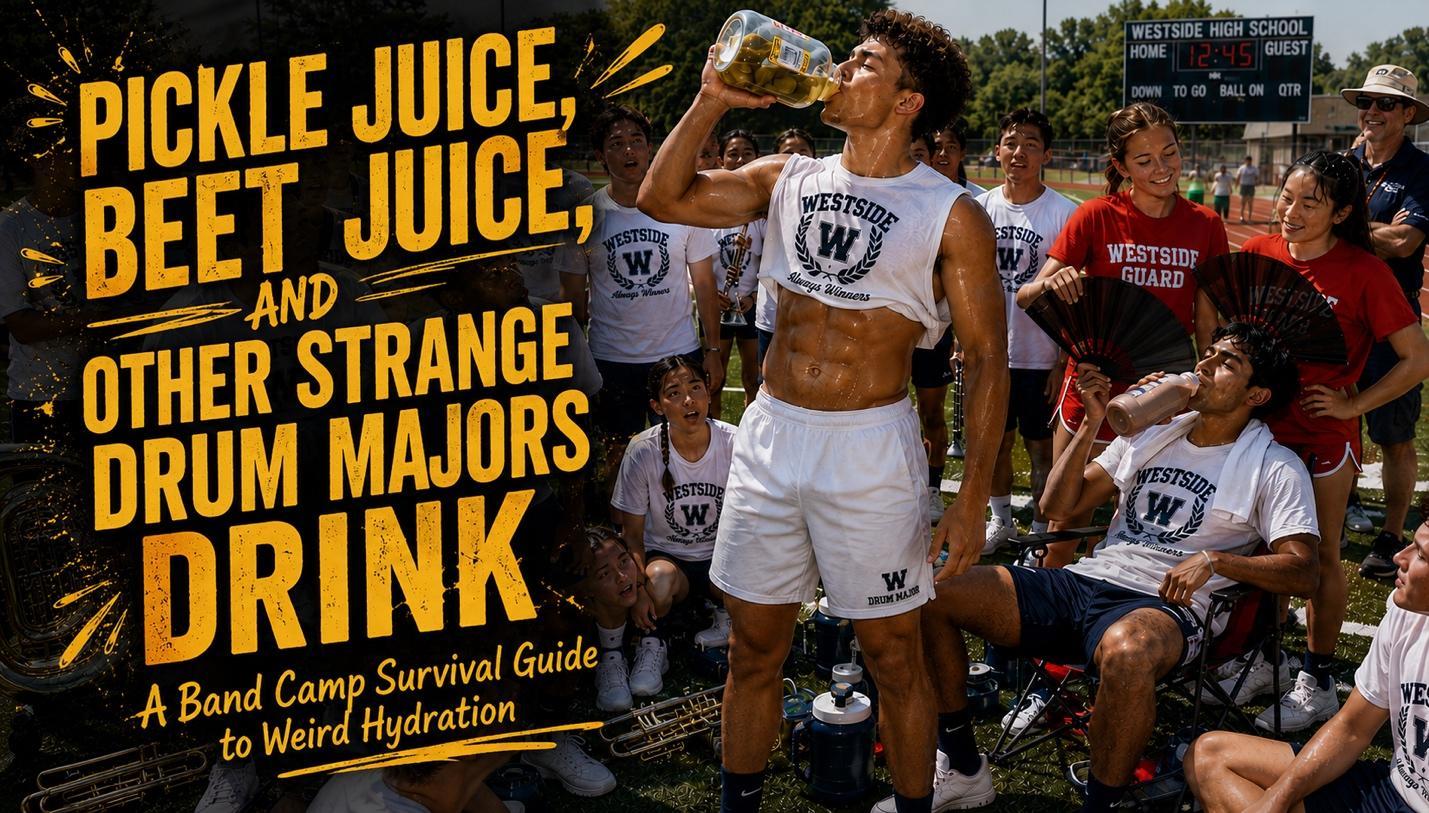
And somewhere near the water cooler, a drum major unscrews a jar and begins drinking pickle juice.
A freshman sees this.
The freshman immediately has questions.
Important questions.
Questions such as:
"Is the drum major okay?"
"Was that an accident?"
"Shouldn't somebody be in charge here?"
The answer is simple.
The drum major is intentionally drinking pickle juice.
And perhaps even more alarming...
the other drum majors don't seem surprised.
One of them asks:
"Can I have some?"
At this point the freshman begins reconsidering every decision that led to joining marching band.
Because while most people think band camp is about music, marching, and memorization...
veteran band students know it's also about surviving the strange world of Band Camp
Hydration.
The Ancient Search for Energy
For thousands of years, athletes have searched for ways to run faster, jump higher, recover quicker, and avoid cramps.
Sometimes the solutions were brilliant.
Sometimes the solutions were strange.
And occasionally the solutions sounded like they were invented during a dare.
The result is a fascinating collection of beverages that range from surprisingly effective to mildly concerning.
Let's begin with the undisputed champion of weird hydration.
Pickle Juice
The Official Beverage of Confused Freshmen
Few drinks have created more questions at band camp than pickle juice.
The first time a freshman sees someone drinking it, they immediately assume something has gone terribly wrong.
The second time they see it, they become curious.
By their junior year, they're carrying their own jar.
Pickle juice contains large amounts of sodium, which helps replace electrolytes lost through sweating.
And if you've ever spent four hours marching in August while carrying a sousaphone, mellophone, or drum, you know sweating is not merely a possibility.
It is a lifestyle.
Freshman Reaction:
"Eww."
Senior Reaction:
"Pass the jar."
Drum Major Reaction:
"Is there any left?"
Beet Juice
The Drink That Causes Panic
Distance runners, cyclists, and endurance athletes often drink beet juice because it contains nitrates that may improve blood flow and stamina.
So far, so good.
The surprise comes later.
Because beet juice can turn things red.
The first time this happens, many athletes become convinced they need immediate medical attention.
Doctors have become familiar with this conversation.
"Have you been drinking beet juice?"
"Oh."
Problem solved.
Chocolate Milk
The Greatest Discovery in Sports Science
Imagine being told by a sports nutrition expert:
"After intense exercise, I recommend chocolate milk."
Most students would assume this advice came from another student.
Instead, it came from science.
Chocolate milk contains carbohydrates, protein, electrolytes, and nutrients that help recovery.
In other words, one of the most effective recovery drinks ever discovered was already sitting in your school cafeteria.
This remains one of humanity's finest achievements.
Coconut Water
Nature's Sports Drink
Long before sports drinks existed, coconuts were solving hydration problems.
Coconut water naturally contains potassium and electrolytes.
It also makes people feel healthy simply by holding it.
Scientists remain uncertain whether this effect is nutritional or psychological.
Honey Water
The Original Energy Drink
Before energy drinks came in shiny cans with names that sound like military operations, athletes used honey.
Ancient Greek competitors often mixed honey and water for energy and endurance.
This means some modern athletes are paying premium prices for beverages that are essentially upgraded versions of something invented before indoor plumbing.
Progress is a complicated thing.
Mustard Packets
We Promise This Is Real
Some athletes consume packets of yellow mustard to help prevent muscle cramps.
Not on food.
Not with food.
Just mustard.
By itself.
This raises an important historical question.
Who was the first athlete to squeeze mustard into their mouth and think:
"That worked."
History offers no explanation.
What About Sports Drinks?
Sports drinks absolutely have a place.
They help replace fluids and electrolytes during extended physical activity.
But most sports nutrition experts agree on one important point.
Water is still king.
Not neon blue water.
Not electric green water.
Just regular water.
This fact disappoints many teenagers every year.
Take Note
The Drum Major Hydration Pyramid
Researchers have identified the five basic nutritional needs of a drum major.
- Water
- More Water
- Even More Water
- Sleep
- Water Again
Contrary to popular belief, drum majors cannot survive solely on authority and hand signals.
The Band Camp Beverage Hall of Fame
Freshman Gross-Out Ratings
Beverage
Gross-Out Rating
Water
1
Chocolate Milk
2
Coconut Water
4
Honey Water
5
Beet Juice
7
Pickle Juice
9
Mustard Packets
11
Mustard remains the only substance ever to exceed the traditional ten-point scale.
Final Note
As band camp continues, the freshman begins noticing something.
The students who seem to survive the heat best all have one thing in common.
They pay attention to hydration.
Some choose water.
Some choose sports drinks.
Some choose coconut water.
Some choose pickle juice.
And one mysterious senior appears to be drinking something from an unlabeled jug that should probably be examined by scientists.
The point is not necessarily what they drink.
The point is that they understand something important.
Band camp is athletic.
Marching is physical.
Heat is real.
Hydration matters.
And somewhere between the first day of band camp and the final football game, most students learn a valuable lesson.
Sometimes the strangest-looking solution has a surprisingly logical explanation.
Except mustard.
We're still trying to figure out the mustard.