Right now, you may be standing at band camp in the least glamorous outfit you own.
A faded T-shirt.
Athletic shorts.
Old tennis shoes.
A baseball cap.
Sunscreen.
Sweat.
Lots of sweat.
Nobody looks fully put together during band camp.
But everyone knows something is coming.
The uniform.
And today, that question feels bigger than ever.
Will your band wear the traditional uniform that has represented your school for decades?
Will you need a new size because you somehow grew four inches and fifteen pounds since
last season?
Will this year's show have a completely new look?
Will the colors match the theme?
Will the jacket be modern?
Will the design be dramatic?
Will there be capes, overlays, printed tops, or sleek performance wear?
And maybe the biggest question some students are asking...
Will this be one of those years when the band doesn't wear hats at all?
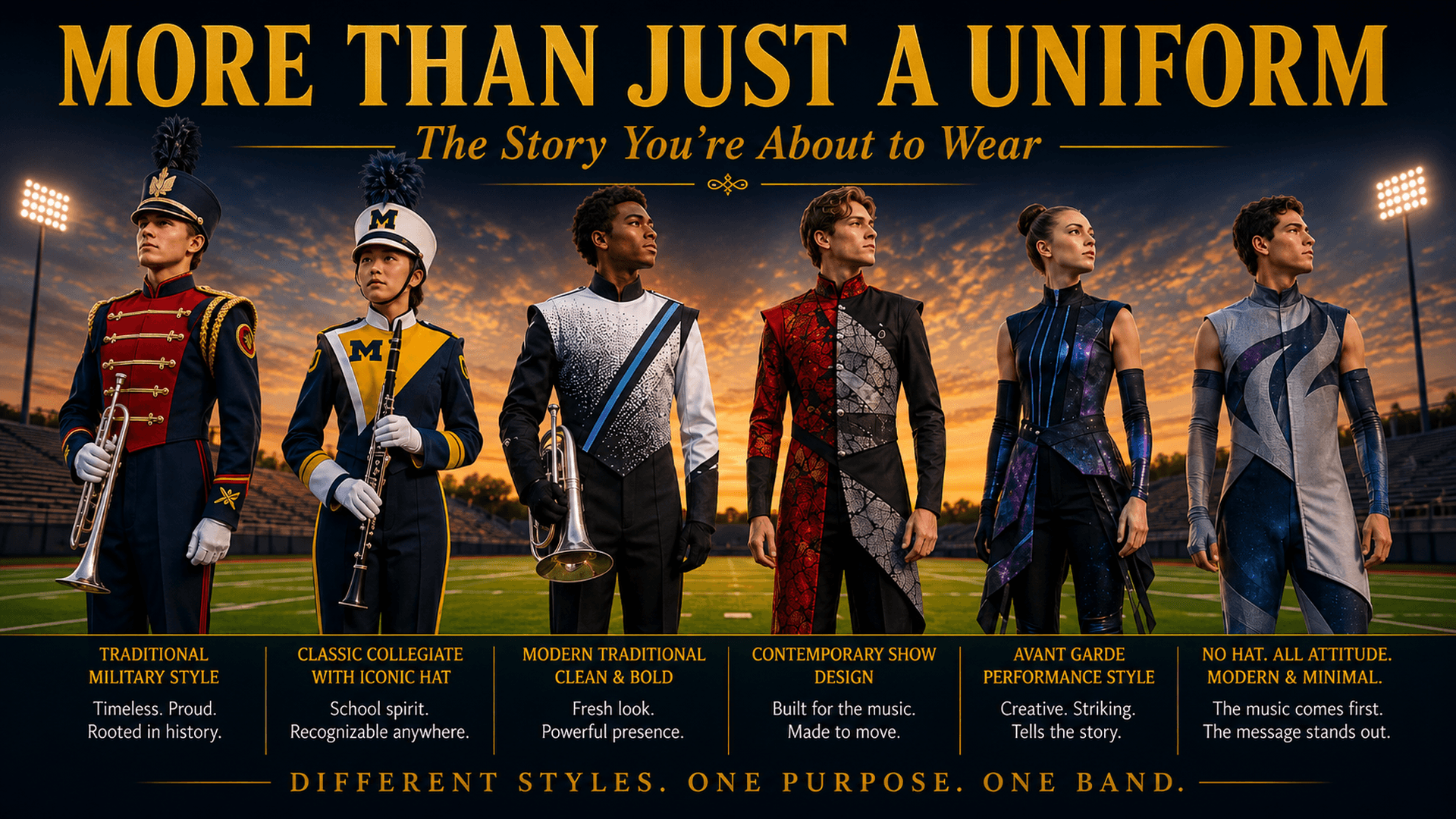
Marching band uniforms are changing faster than ever. Many bands now choose new
uniforms, show-specific costumes, or themed performance looks each season. Some still
march proudly in classic uniforms with shakos and plumes. Others are stepping onto the
field in modern designs that look closer to theater, dance, or drum corps.
But whether your band wears a fifty-year-old uniform or a brand-new performance
costume...
The moment is still the same.
You put it on.
You look in the mirror.
And suddenly...
You are no longer just another sweaty student at band camp.
You are part of the band.
Every Uniform Has a Story
Have you ever wondered why marching band uniforms look the way they do?
Why the tall hats?
Why the shiny buttons?
Why the decorative braids across the front?
Why the shoulder cords?
Why the gloves?
Why do so many uniforms still resemble military dress uniforms?
The answer begins...
Not on a football field.
But on a battlefield.
More than two thousand years ago, armies relied on musicians to communicate across
noisy battlefields. Drums kept soldiers marching together. Trumpets and horns signaled commands that could be heard over the sounds of battle.
Those musicians had to be easy to recognize.
Their uniforms were colorful.
Their hats were tall.
Their appearance inspired confidence and discipline.
Over time, military bands became symbols of pride, precision, and excellence.
When schools eventually began forming marching bands, they borrowed many of those traditions—not because students were preparing for war, but because they were learning teamwork, discipline, leadership, and musical excellence.
The uniform became a symbol of belonging.
Then the Uniform Began to Change
For much of the twentieth century, marching band uniforms changed very little.
Schools often wore the same uniform for twenty, thirty, or even fifty years.
Thousands of students proudly marched in exactly the same jacket and hat worn by generations before them.
The uniform became part of the school's identity.
Parents remembered wearing it.
Grandparents recognized it.
Alumni smiled whenever they saw it.
Then marching bands began evolving.
Shows became more theatrical.
Music became more visual.
Drill became more artistic.
Instead of simply performing songs, bands began telling stories.
And when the shows changed...
The uniforms began changing too.
Today, many marching bands design an entirely new look every season.
One year the band may appear as astronauts.
The next year as ancient warriors.
Another year as abstract works of art.
Uniforms are now designed to help tell the story of the music.
Some schools still proudly wear traditional military-style uniforms complete with shakos
and tall plumes.
Others have replaced them with lightweight jackets, stretch fabrics, flowing overlays, and
custom graphics designed specifically for one production.
Some bands have even said goodbye to hats altogether, allowing facial expressions and
visual storytelling to become part of the performance.
There is no single "right" way anymore.
Every band chooses the style that best tells its story.
Your Uniform Is More Than Clothing
When your band director hands you your uniform, you're not simply receiving something to wear.
You're accepting a responsibility.
That uniform represents your school.
Your directors.
Your community.
Your parents who fill water coolers and volunteer at competitions.
Your boosters who helped raise the money to purchase it.
Your alumni who once stood exactly where you're standing now.
And every student who will someday wear it after you.
Whether it cost $800 or $8,000...
Whether it has been worn for fifty years or was delivered last month...
The meaning is exactly the same.
For one season...
It becomes yours.
Treat it with respect.
Hang it up properly.
Keep it clean.
Take care of it.
Because it represents something much larger than yourself.
The First Time You Wear It
Ask almost any band student about the first football game of the season.
Many won't remember the final score.
They probably won't remember what they ate before the game.
But they'll remember the first time they wore the complete uniform.
The jacket.
The pants.
The gloves.
The shako.
The plume.
Or perhaps...
No shako at all.
You'll look around the band room.
Everyone who spent August looking sweaty, exhausted, and sunburned suddenly looks
completely different.
The freshmen suddenly look like veterans.
The seniors stand just a little taller.
The band no longer looks like a group of students.
It looks like one team.
One organization.
One family.
Then the doors open.
The stadium lights come into view.
The crowd begins filling the stands.
And for the first time...
You understand why everyone was so excited about getting the uniform.
What You Wear Is Temporary
What It Represents Is Forever
Someday you'll return the uniform.
Someone else will wear it.
Or perhaps your school will unveil an entirely new design.
Either way...
The uniform itself isn't what people remember most.
They remember the people inside it.
The friendships.
The laughter on bus rides.
The long rehearsals.
The impossible August afternoons.
The championships.
The disappointments.
The standing ovations.
The final halftime performance as a senior.
Years from now, someone may pull an old photograph from a scrapbook.
You'll smile.
Not because of the jacket.
Not because of the hat.
Not because of the plume.
You'll smile because you'll remember exactly how you felt wearing it.
Proud.
Confident.
Part of something bigger than yourself.
Take Note
Today's marching band uniforms may look completely different from those worn fifty years ago.
Next year's may look different from this year's.
Styles will change.
Colors will change.
Designs will change.
Even the famous marching hat may continue to disappear from more football fields.
But one thing never changes.
The moment a student puts on a marching band uniform for the first time...
They stop thinking about how they look.
And they begin thinking about what they represent.
That's when a uniform becomes much more than fabric.
It becomes tradition.
It becomes responsibility.
It becomes pride.
And for one unforgettable season...
It becomes part of your story.